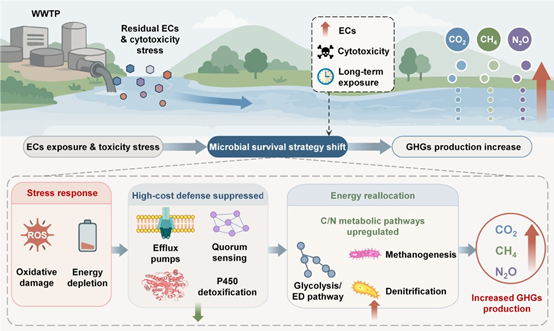
Shenzhen, September 14 - Recently, the team of Professors Wang Aijie and Han Jinglong at Harbin Institute of Technology, Shenzhen (HITSZ) made new progress in water environment research, identifying the intrinsic mechanism by which emerging contaminants promote greenhouse gas generation in receiving rivers. The findings were published in Nature Water.
Tailwater discharged into rivers after wastewater treatment plants still contains residual emerging contaminants, among which pharmaceutical and pesticide substances are the main contributors to ecological risks and enhance greenhouse effects. The study shows that river microorganisms would adjust their survival and metabolic strategies under long-term emerging contaminant stress, including reducing defense expenditure and enhancing material metabolism, thereby generating more greenhouse gases in rivers.
Based on these findings, the team recommends that wastewater treatment processes should be optimized to minimize residual emerging contaminants and reduce environmental risks in receiving water. This research was supported by the National Natural Science Foundation of China and the Shenzhen Science and Technology Program, with Beijing JENSEND Environmental Protection Technology Co., Ltd. providing venue support. Professors Wang Aijie and Han Jinglong are co-corresponding authors of the paper.